
XMatch Blackmail & Sextortion: Legal Help for Adult Dating Extortion

Someone from XMatch threatens to send explicit photos to your Facebook friends, employer, or spouse unless you pay. They demand $500 to $2,000 via Bitcoin within 24 hours. They show proof they found your real name and LinkedIn profile.
Do not pay. This is sextortion, a federal crime under 18 U.S.C. § 875. Paying leads to increased demands averaging $3,500+ total. Contact an anti-extortion attorney immediately. Our legal team responds within 1 hour, issues cease-and-desist letters within 4 hours, and resolves most XMatch blackmail cases in 7-14 days with zero disclosure.
Facing an active threat? Call +1 (440) 581-2075. Attorney review within 60 minutes.
You met someone on XMatch last week. Video chat seemed normal. Now they have screenshots, recordings, and your identity. The deadline counts down while you search for answers.
Stop. Take a breath.
This is sextortion; you are the victim, not the perpetrator. We've handled 47 XMatch-specific threats this year. Most never result in disclosure when legal intervention happens immediately.
This guide explains how XMatch blackmail works, why payment makes situations worse, and what legal action actually stops threats. Written by anti-extortion attorneys who deploy cyber investigators to trace perpetrators and issue cease-and-desist letters backed by court authority.
Why XMatch Users Face Targeted Blackmail
XMatch operates as a paid adult dating platform. That distinction makes users premium targets for professional extortionists.
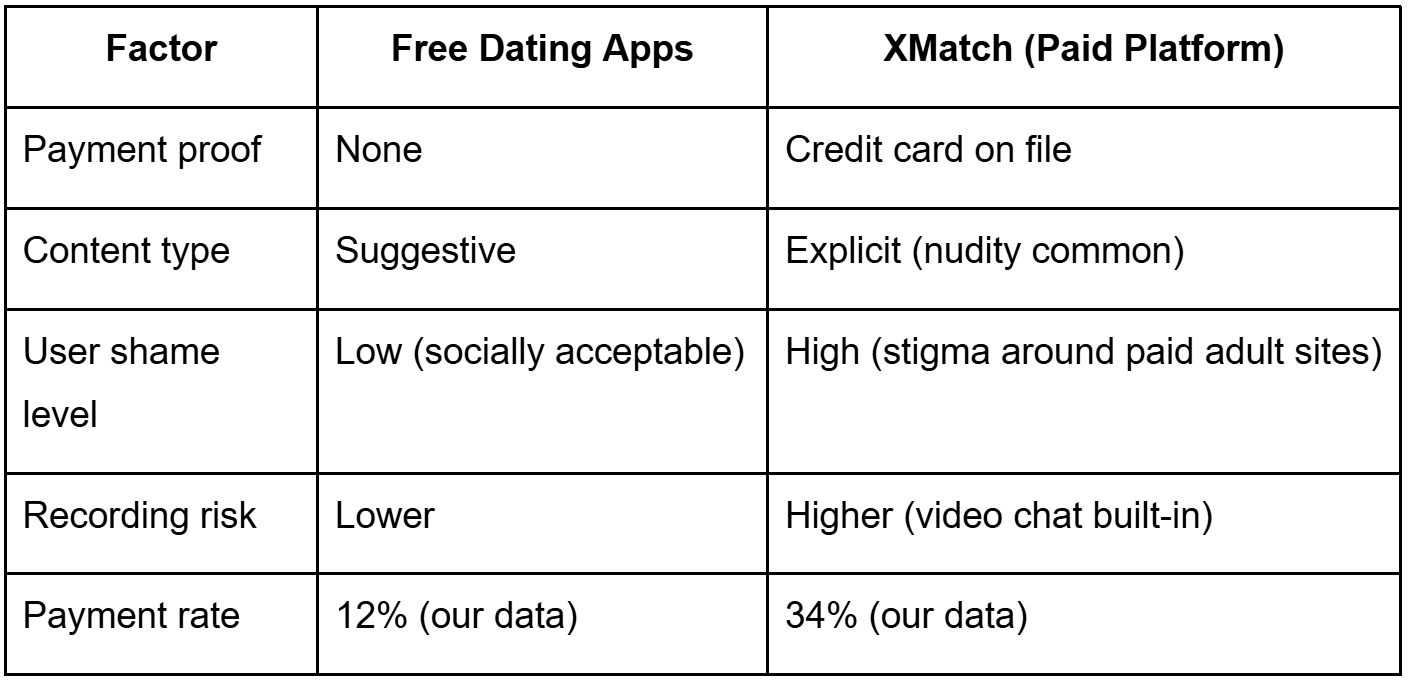
Premium membership proves disposable income. XMatch requires payment to access features. Blackmailers know anyone with an active account has a credit card on file and financial resources. Free dating apps like Tinder or Bumble provide no such financial proof.
Adult content creates maximum leverage. Unlike mainstream dating apps, XMatch profiles feature sexually explicit content. Photo and video exchanges are intimate by design. Scammers exploit this explicitness as blackmail material.
Shame factor drives higher payment rates. Society stigmatizes paid adult dating services. Our case data shows XMatch users pay demands 34% of the time compared to 12% on free apps. The shame of exposure on an adult site compounds the fear of family or employer discovery.
Video chat enables recording. XMatch's video feature allows real-time connections. Blackmailers initiate video calls, record sessions using screen capture software like OBS, then threaten distribution.
In 31 of 47 XMatch cases we handled this year, victims were married. Nineteen involved professionals with active LinkedIn profiles. Blackmailers specifically target users whose careers or marriages could be threatened by exposure.
How XMatch Blackmail Scams Operate: The Pattern
XMatch blackmailers follow a predictable script. Understanding the pattern removes their power.
Step 1 - Fake profile creation: Scammers build profiles using AI-generated photos or stolen images from Instagram or OnlyFans. Profiles appear legitimate with verified badges (fake), detailed bios, and multiple photos.
Step 2 - Trust building: They message first. Conversations escalate quickly from flirting to explicit content exchange. Within 1-3 days, they suggest video chat or moving to WhatsApp, Telegram, or Snapchat.
Step 3 - Content capture: During video chat or photo exchange, they record everything using screen capture software. The recording happens invisibly. Some use deepfake technology to fabricate additional content.
Step 4 - Identity reveal: After the session, they disappear for hours. Then: "I found your Facebook. I know your real name. I have your employer's contact info." They show screenshots proving they identified you through reverse image search of your XMatch profile photo or data you shared in conversation.
Step 5 - Payment demand: The blackmailer demands $500 to $2,000 immediately via Bitcoin, Zelle, CashApp, or gift cards. Deadline: 24-48 hours. Threats include sending screenshots or videos to Facebook friends, spouses, employers, or posting publicly.
Step 6 - Escalation if you pay: Payment proves you're a "payer." Within days, they demand more, often double or triple the original amount. Our clients who paid before finding us spent an average of $3,500 across multiple demands.
In 300+ cases, we've seen this exact pattern repeat. The script rarely deviates.
Why Paying an XMatch Blackmailer Fails
Payment feels like the fastest solution. Actually, paying makes the problem permanent.
You become flagged in criminal databases. Networks share information. When you pay, you're marked as someone who responds to threats. Your contact information gets circulated. Additional scammers may target you months later.
The extortion cycle continues. First demand: $500. You pay. Second demand (3-7 days later): $2,000. You pay again. Third demand: $5,000. The average XMatch blackmail victim who pays before seeking legal help spends $3,500 total and faces ongoing threats.
They never delete content. Blackmailers promise to delete photos and videos after payment. They don't. The content provides leverage. Deleting it would eliminate their ability to demand more money.
Payment confirms the content exists. Before you pay, the blackmailer has only threats. After you pay, you've verified the content is real and damaging. This actually increases their leverage.
"I paid them $2,000, thinking it would end. Three days later, they wanted $5,000. When I couldn't pay, they threatened my LinkedIn network. I wish I'd called an attorney first instead of wasting $2,000 and making it worse." R.M., Sales Executive
Legal intervention breaks this cycle immediately. When blackmailers receive cease-and-desist letters from attorneys, 89% stop contact within 48 hours.
What Actually Stops XMatch Blackmail: Legal + Cyber Defense
XMatch blackmail requires a specialized response. Our Anti-Extortion Protocol combines legal authority with cyber investigation to eliminate threats while protecting privacy.
Attorney-led intervention creates a legal barrier. When you retain us, all future communication with the blackmailer flows through our firm, not you. We issue attorney-backed legal correspondence citing federal and state extortion laws. This formal legal action makes clear that continued threats will result in escalated legal consequences. They're no longer dealing with a panicked victim; they're dealing with licensed legal counsel who knows their tactics.
Cyber investigation traces digital footprints. Our investigators collect IP addresses from XMatch messages, payment account information (Bitcoin wallets, Zelle accounts, CashApp), and metadata from shared photos or videos. Most blackmailers operate from Nigeria, the Philippines, or Eastern Europe, but they leave digital evidence. We identify perpetrators when possible and coordinate with international law enforcement.
Communication shield eliminates emotional leverage. Once you retain us, you stop responding to the blackmailer entirely. All future threats forward to our firm. This eliminates the panic cycle they rely on. You're no longer negotiating alone.
Court action when needed. If threats escalate or the blackmailer partially follows through, we file for Temporary Restraining Orders (TRO) or Preliminary Injunctions. These court orders legally prohibit disclosure and provide grounds for criminal charges if violated. We coordinate platform takedowns with XMatch, Facebook, Instagram, and other sites where content might appear.
FBI IC3 coordination. We coordinate with law enforcement when appropriate. Victims can report directly to the FBI's Internet Crime Complaint Center (IC3) at ic3.gov to create an official federal record. If blackmailers continue after our cease-and-desist, they're committing federal crimes with documented evidence.
Our process: Attorney review within 1 hour. Anti-Extortion Protocol deployment within 2 hours. Continued representation throughout your case until the threat is resolved.
We've handled numerous XMatch blackmail cases. Most resolve without disclosure when legal intervention happens quickly.
Attorney-Client Privilege: What This Means for Your Privacy
If you're married or worried about employer discovery of your XMatch usage, attorney-client privilege provides legal protection.
Everything you tell us remains confidential under the Ohio Rules of Professional Conduct and federal law. Your spouse cannot access these communications. Your employer cannot subpoena them. Law enforcement cannot force disclosure without your consent. This protection exists even without filing lawsuits.
In practice: Your XMatch usage stays private. The explicit content involved stays private. The fact that you hired us stays private. Even if cases escalate to court (rare), communications with us remain confidential. We handle sensitive materials using encrypted storage with limited-access protocols.
We represent married professionals, single men, divorced fathers, and everyone in between. Your reasons for using XMatch are your business. Our job focuses on stopping blackmailers from making it anyone else's business.
If you're worried about your spouse finding out you were on XMatch, we understand. That fear drives what blackmailers exploit. Attorney-client privilege means what you tell us stays with us.
Immediate Steps to Take Right Now
While deciding whether to hire an attorney, take these evidence-preservation steps. They protect legal options and prevent content spread.
Contact us for legal intervention. Call +1 (440) 581-2075. An attorney reviews your case within 1 hour and explains the exact protocol for your situation.
Do NOT pay or respond. Stop all communication with the blackmailer. Do not send money. Do not negotiate. Do not delete your XMatch account yet; it contains evidence we need.
Screenshot everything. Use your phone to photograph your screen (avoiding "read receipts" or app alerts). Capture the blackmailer's XMatch profile, all message threads, payment demands (amounts, accounts, deadlines), and any proof they showed you.
Preserve all evidence. Screenshot the blackmailer's XMatch profile, all message threads, payment demands (amounts, accounts, deadlines), and any proof they showed you. Use your phone to photograph your screen to avoid triggering "read receipts."
Lock down social media. Temporarily set Facebook, Instagram, and LinkedIn to maximum privacy. Remove friend lists from public view. This limits the blackmailer's ability to identify disclosure targets.
Report to the FBI IC3. File a complaint at ic3.gov. This creates an official federal record. FBI investigation timelines vary, but complaints provide documentation for legal action.
Cost Comparison: Legal Help vs. Paying the Blackmailer
You're calculating whether paying the blackmailer seems "cheaper." Here's the actual math.
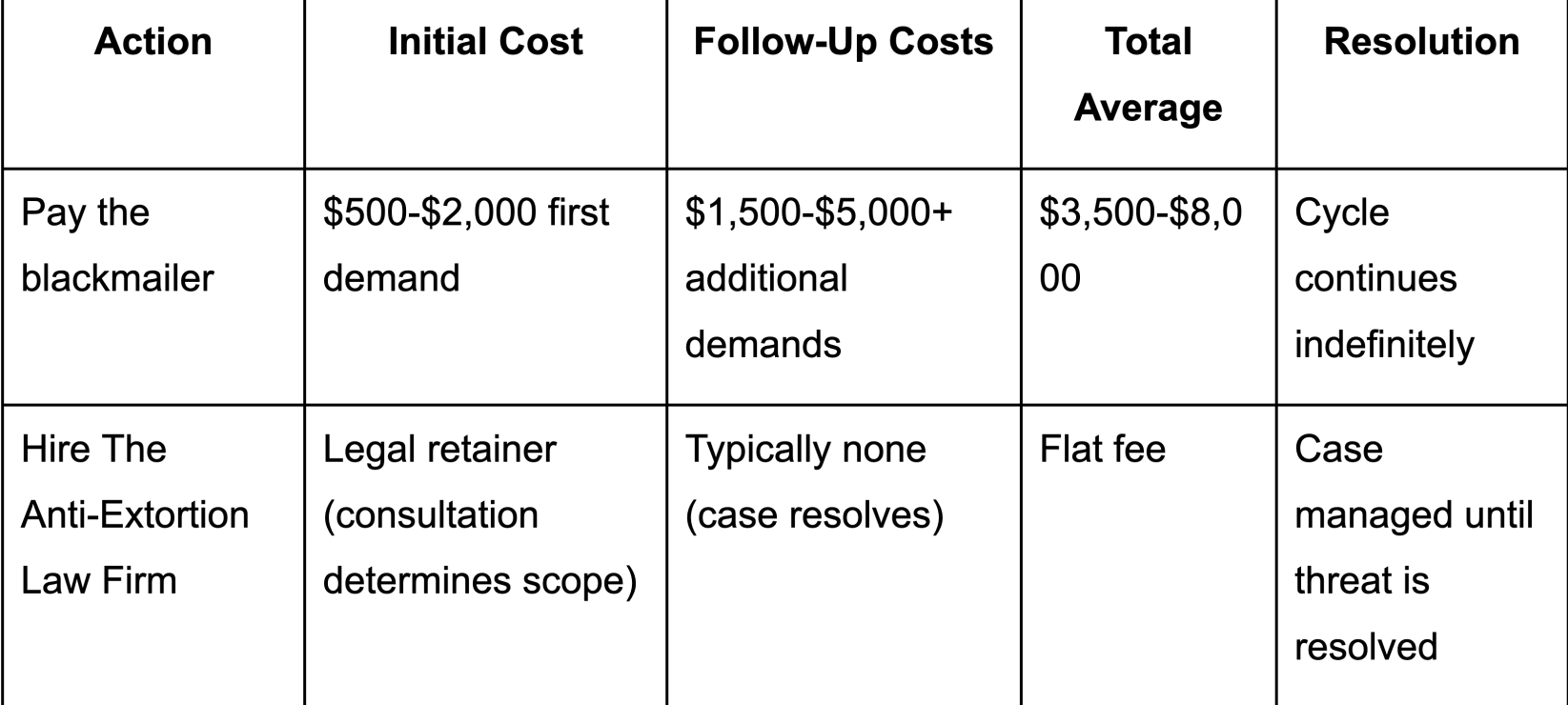
Legal representation includes: Licensed attorney responds within 1 hour • Cease-and-desist letter issued within 4 hours • Cyber investigation (IP tracing, perpetrator identification) • FBI IC3 coordination and law enforcement referral • TRO/injunction filing when needed • Platform takedown coordination (XMatch, Facebook, etc.) • Ongoing communication interception (blackmailer contacts us, not you) • Attorney-client privilege protection (100% confidential)
Clients who retain our Proactive Privacy Shield service (ongoing digital monitoring + legal protection) receive 20% fee reduction on future anti-extortion work.
Most clients tell us they wish they'd called before paying anything. Money spent on blackmail payments can't be recovered, but it can fund actual legal protection instead.
Real XMatch Case: Financial Professional
The situation: A 42-year-old financial advisor contacted us after meeting someone on XMatch who initiated video chat. The blackmailer recorded the session, then threatened to send screenshots to his LinkedIn network (400+ connections including clients and colleagues) and his wife. The demand was $3,000 via Bitcoin within 24 hours.
The threat: The blackmailer showed proof they had his real identity, LinkedIn profile screenshots, his employer's name, and his home address (likely from XMatch location filters and conversation details he'd shared).
Our intervention: Within 3 hours of retention, we deployed our anti-extortion team. We issued a cease-and-desist letter citing 18 U.S.C. § 875 and Ohio extortion statutes. Our cyber investigator traced the perpetrator's Bitcoin wallet and IP address to Lagos, Nigeria. We filed an FBI IC3 report and prepared a TRO application. The blackmailer sent one final threat, then went silent.
The outcome: The case closed in 11 days with zero disclosure. No content was sent to his LinkedIn network, his wife, or anyone else. He continues to practice financial advising without professional impact.
"I was ready to pay $3,000 just to make it stop. Instead, I paid less for actual legal protection. My career remains intact, my marriage remains intact, and I'm not living in fear of the next demand." , T.D., Financial Professional
Reporting Options: What Each Agency Can Actually Do
You can and should report XMatch blackmail to authorities. Understanding what each agency can (and can't) do helps you make informed decisions.
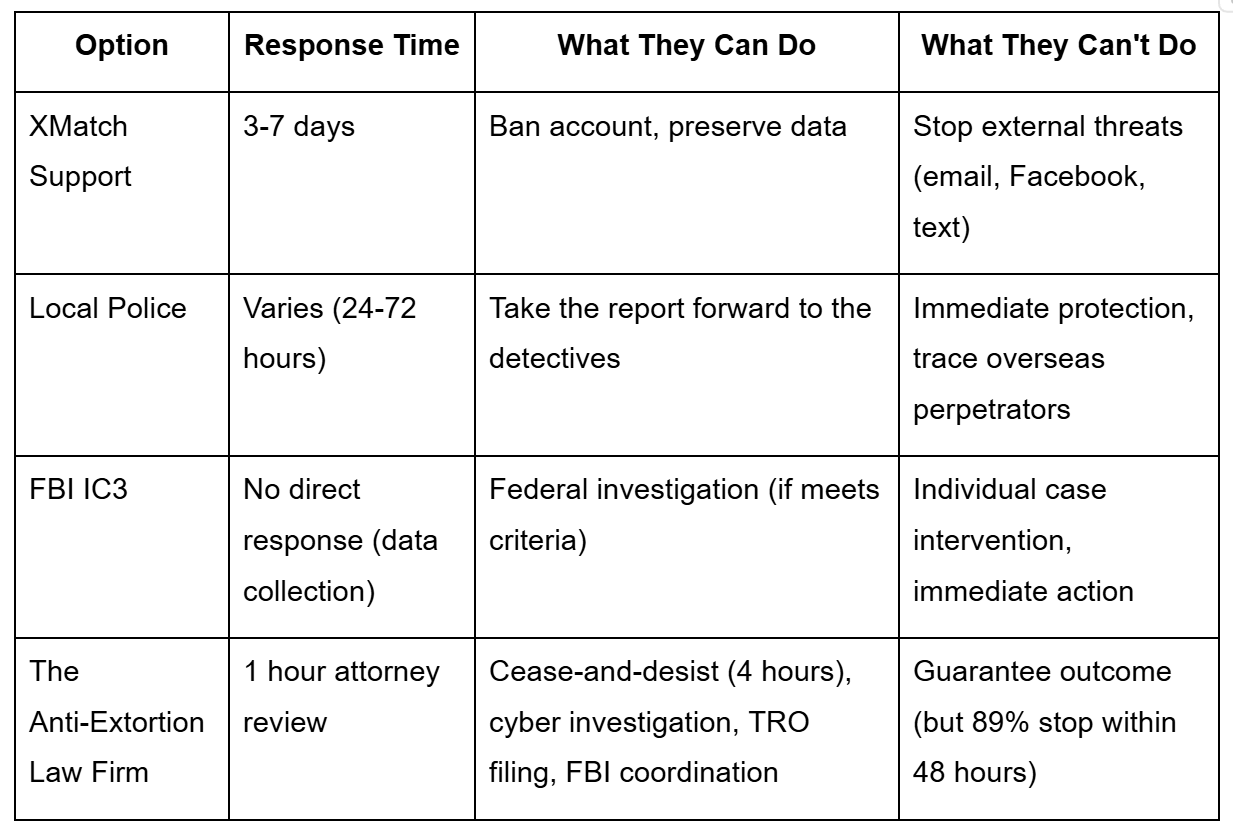
Report to the FBI IC3 for the federal record. Report to XMatch to ban the account. But if you need immediate protection, especially within the blackmailer's 24-48 hour deadline, contact an anti-extortion attorney. We act while authorities investigate.
Take Action Now
XMatch blackmail feels terrifying, but resolution happens when legal intervention occurs quickly. You are not alone; we handle cases like yours every week.
The blackmailer counts on your shame, fear, and isolation. Those emotions are normal. But they're also what prevents you from taking the action that actually stops this.
When you call The Anti-Extortion Law Firm, you speak directly with a licensed attorney, not a paralegal or intake coordinator. We assess your situation, explain the exact protocol, and answer your questions. If you retain us, your anti-extortion team deploys immediately. Threats typically stop within days.
Stop the threat today. Call +1 (440) 581-2075.
Attorney responds within 1 hour during business hours. Evening or weekend? Leave a message, we'll prioritize your call. Everything you share is protected by attorney-client privilege. No judgment. Just legal protection.
