
Emotional Blackmail vs. Criminal Blackmail: When to Call an Attorney

Emotional blackmail uses fear, obligation, and guilt to manipulate behavior in relationships. Criminal blackmail involves threats to expose information unless a victim pays money or complies with demands.
Emotional manipulation becomes a crime when someone threatens reputation harm, demands payment, or uses intimate images for leverage. Attorneys handle cases involving money demands, sextortion, workplace threats, or affair exposure.
Attorney-client privilege protects criminal blackmail cases from becoming public records, unlike police reports that expose professional reputation.
What Is Emotional Blackmail?
Emotional blackmail is psychological manipulation using fear, obligation, and guilt (FOG) to control someone's behavior in personal or professional relationships. Clinical social worker Susan Forward popularized the FOG framework. The manipulator weaponizes emotions to force compliance without making criminal threats.
Common Emotional Blackmail Patterns
Self-Punishment Threats: "If you leave me, I'll hurt myself" or "I can't live without you."
Guilt-Tripping: "After everything I've done for you..." or "You're being selfish."
Punishment Manipulation: Silent treatment, withholding affection, or emotional withdrawal.
Obligation Weaponization: "You're destroying this family" or "Think about what people will say."
Where Emotional Blackmail Occurs
Romantic relationships between spouses, partners, or affair situations. Family dynamics involving parents, siblings, or adult children. Workplace relationships with colleagues, supervisors, or subordinates.
Important distinction: Emotional blackmail is manipulative and toxic, but generally NOT criminal. This is relationship abuse territory, not legal intervention.
What Is Criminal Blackmail? Legal Definition
Criminal blackmail, legally defined as extortion, occurs when someone threatens to expose damaging information, cause harm, or file false accusations unless a victim pays money, provides property, or performs specific acts.
Ohio law defines extortion under R.C. 2905.11 and coercion under R.C. 2905.12. Federal law addresses blackmail through 18 U.S.C. § 873, which criminalizes threatening to accuse someone of a crime for payment.
Three Required Criminal Elements
Element 1: Threat The perpetrator threatens to expose secrets, harm reputation, cause physical damage, or file false accusations. The threat must be specific and credible.
Element 2: Demand The perpetrator demands money, property, sexual compliance, business advantage, or specific actions. The demand must have tangible value.
Element 3: Intent The perpetrator intends to coerce the victim through fear. The goal is personal gain or forcing compliance through threatened consequences.
Criminal Blackmail Examples
"Pay me $5,000 by Friday or I send affair photos to your spouse and employer."
"Give me $10,000 or I report you to your professional licensing board for misconduct."
"Send explicit videos or I release intimate images to your social media contacts."
"Transfer vehicle title to me or I tell police you assaulted me."
Understanding how to tell if sextortion email is real helps victims distinguish mass scam emails from targeted criminal blackmail threats requiring immediate attorney intervention.
Criminal Penalties
Felony extortion charges carry severe consequences. Federal sentences reach 20 years imprisonment. Fines extend to $250,000. Conviction creates permanent criminal records affecting employment, professional licenses, and security clearances.
Is Emotional Blackmail Illegal? Key Differences
Emotional blackmail alone is generally NOT illegal unless the manipulation crosses into criminal territory by including threats to expose information combined with demands for money, property, or sexual compliance.
Legal vs. Criminal Comparison
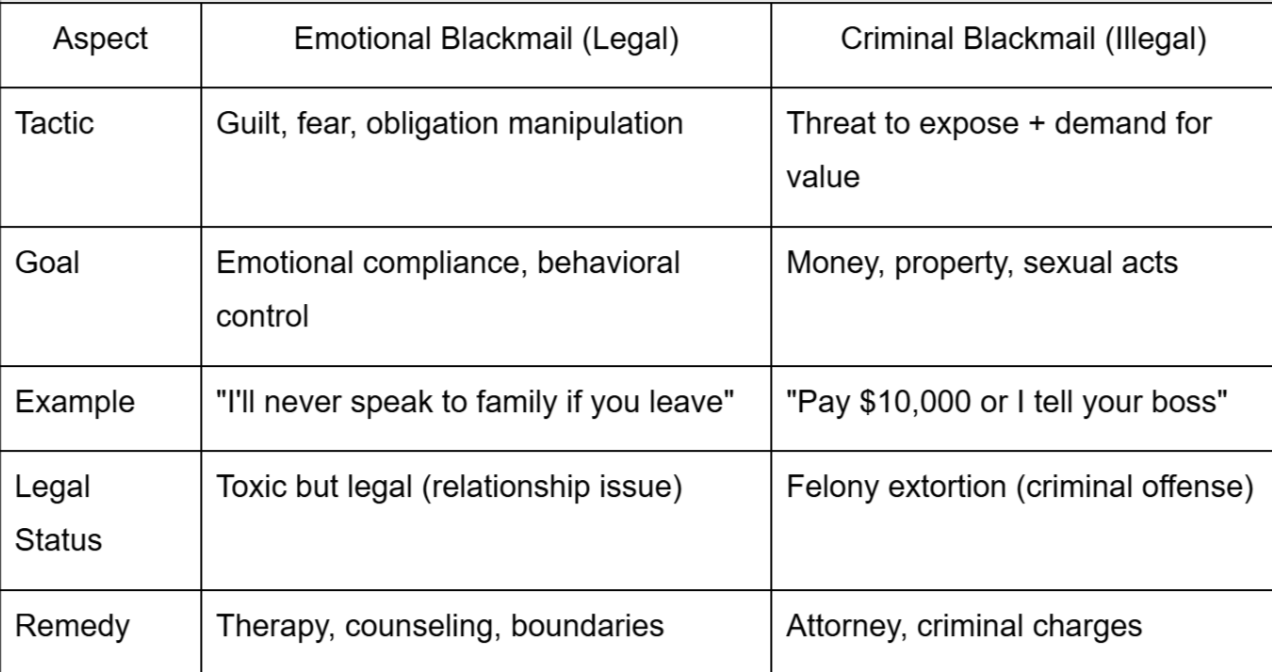
When Emotional Becomes Criminal
Money Demands: Affair partner demands $20,000 to stay silent about the relationship. Learn about affair partner blackmail and legal options
Career Threats: Colleague threatens employer notification unless receiving business favor or promotion.
Property Coercion: A family member threatens false accusations unless receiving inheritance early.
Sexual Leverage: Someone demands sexual compliance in exchange for not exposing embarrassing information.
The criminal line crosses when emotional pressure adds tangible demands backed by exposure threats. Professionals facing Reddit affair sextortion, or escort blackmail situations experience this escalation from relationship conflict to criminal extortion.
5 Elements That Make Blackmail a Crime
Courts determine criminal blackmail by evaluating five specific elements: threat type, demand nature, perpetrator intent, threat legitimacy, and the victim's reasonable fear.
1. Threat to Expose or Harm
Reputation Threats: Reveal affair, sexual history, embarrassing information, or professional misconduct.
Career Threats: Notify employer, contact licensing board, expose confidential business information.
Legal Threats: File false police reports, make false assault accusations, threaten immigration consequences.
Physical Threats: Harm to the victim, family members, or property damage.
2. Demand for Something of Value
Money: Specific amounts with deadlines ("$5,000 by Friday").
Property: Business assets, vehicle titles, real estate transfers, or valuable items.
Sexual Compliance: Demands to perform acts, send explicit content, or continue unwanted relationships.
Business Advantage: Force contracts, reveal confidential data, or resign from positions.
3. Intent to Coerce
The perpetrator structures threats as ultimatums. Victims must comply OR suffer threatened consequences. "Pay or else" formatting creates the coercive element. Conditional threats follow "If you don't X, then I'll Y" patterns.
4. Unwarranted Threat
The perpetrator has no legal right to make the demand. Legitimate debt collection differs from blackmail because legal grounds exist.
Legal demand: "Repay the $5,000 loan or I'll file a small claims court action."
Illegal blackmail: "Pay me $5,000 or I expose your affair to your employer."
5. Victim's Reasonable Fear
The threat must be credible. The blackmailer possesses information, images, or the ability to follow through. The victim reasonably believes exposure will cause significant harm. This fear motivates compliance with demands. Many victims wonder what happens if you ignore a sextortionist; the answer depends on whether the threat is a mass scam or targeted criminal extortion.
When to Call an Attorney vs. a Therapist vs. the Police
Professionals facing threats involving money demands, career damage, or sextortion require confidential attorney assessment, while emotional manipulation without criminal elements calls for therapy or relationship counseling.
Call Attorney Immediately If
Money or Property Demanded: "Pay $X or I expose information to employer/family."
Sextortion Threats: Intimate photos or videos used as leverage for payment or sexual compliance.
Workplace Coercion: Threats of employer notification, professional license complaints, or security clearance damage.
Reputation Blackmail: Affair exposure combined with financial demands or forced actions.
False Accusations: "I'll claim you assaulted me unless you comply with my demands."
Business Extortion: Demands for contracts, confidential information, or resignation under threat.
Professionals targeted through XMatch blackmail schemes or adult massage parlor blackmail need immediate legal protection before situations escalate.
Why Attorney Before Police
Attorney-client privilege protects conversations from becoming public records. Police reports become accessible to employers, licensing boards, and background checks. Attorneys protect professional reputation strategically. They assess evidence quality, coordinate legal responses, and preserve confidentiality throughout proceedings.
Police reports expose the situation immediately. For professionals with careers at risk, confidential attorney review provides strategic options before involving law enforcement.
The Anti-Extortion Protocol addresses criminal blackmail while protecting professional licenses and employment through attorney-client privilege. This confidential process prioritizes career protection over public criminal proceedings.
Consider Therapist Instead If
No Financial Demands: Guilt-tripping and emotional withdrawal without money or property demands.
Relationship Manipulation: Conditional affection, silent treatment, or emotional control tactics.
Family Dynamics: Parent-child conflicts, sibling rivalry, or codependent relationship patterns.
Couples Issues: Communication breakdowns requiring marriage counseling or relationship therapy.
Therapists address emotional manipulation. Attorneys handle criminal threats. Understanding this distinction prevents wasted time and money.
When Police Involvement Is Appropriate
Immediate Physical Danger: Active stalking, violence threats, or safety concerns requiring emergency protection.
After Attorney Consultation: Attorneys coordinate with law enforcement when strategically appropriate.
Ongoing Harassment: Pattern of escalating criminal behavior despite legal warnings.
How to Document Evidence of Criminal Blackmail
Proper evidence preservation, including all messages, timeline documentation, and financial records, determines whether prosecutors can file criminal charges and attorneys can pursue legal remedies.
Evidence Documentation Checklist
Save All Communications: Preserve text messages, emails, voicemails, social media direct messages, and dating app conversations.
Screenshot Everything: Capture full message threads with timestamps, sender information, and context.
Never Delete Messages: Old communications establish threat patterns and escalation timelines.
Create Timeline: Document first threat date, subsequent demands, payment requests, and escalation points.
Preserve Financial Records: Bank statements showing payments made under duress prove financial harm. However, recovering money after sextortion is extremely difficult; prevention through proper legal response is critical.
Identify Witnesses: Note anyone who heard threats, saw messages, or can corroborate the situation.
Maintain Metadata: Keep full email headers, phone numbers, IP addresses, and account information.
Understanding how to collect evidence for online blackmail safely ensures preservation without compromising legal cases or escalating threats.
Critical Actions to Avoid
Do NOT confront the blackmailer directly. Confrontation often escalates threats and destroys potential legal remedies.
Do NOT pay or comply with demands. Payment confirms you're a target, leading to increased demands.
Do NOT delete communications. Evidence destruction weakens legal cases and civil lawsuits.
Do NOT negotiate without attorney guidance. Self-negotiation reveals vulnerabilities that blackmailers exploit.
Professionals facing threats involving money demands, affair exposure, sextortion, or career destruction need immediate confidential legal protection. Attorney-client privilege keeps cases off public records, protecting professional licenses, employment, and family relationships.
The Anti-Extortion Law Firm provides confidential attorney assessments for criminal blackmail cases.
Our specialized approach addresses the unique challenges professionals face when relationship conflicts escalate into criminal extortion.
(440) 581-2075 | Ohio Bar #101457 | 1818 Euclid Ave, Cleveland, OH 44115
Frequently Asked Questions
Q: What is emotional blackmail?
Emotional blackmail is psychological manipulation using fear, obligation, and guilt (FOG) to control someone's behavior in relationships. Common tactics include threats of abandonment, self-harm warnings, guilt-tripping, or conditional affection rather than demands for money or property.
Q: Is emotional blackmail illegal?
Emotional blackmail alone is generally not illegal unless it escalates to include threats to expose information combined with demands for money, property, sexual compliance, or other tangible value. At that point, manipulation becomes criminal extortion under state and federal law.
Q: Is emotional blackmail a crime?
Emotional manipulation becomes a crime when demands arise: "Pay me $5,000, or I expose the affair," "Send explicit videos or I tell your employer," or "Give me business contracts, or I file false police reports." The demand for value transforms manipulation into felony extortion.
Q: Can you go to jail for emotional blackmail?
You cannot go to jail for emotional manipulation tactics. However, criminal blackmail carries serious penalties, including federal prison sentences, substantial fines, and permanent felony records when threats to expose information combine with demands for money, property, or sexual compliance.
Q: When should I call an attorney for blackmail?
Contact an attorney immediately when threats involve money demands, workplace notification, intimate image leverage, professional license threats, or false accusations. Attorney-client privilege keeps cases confidential, protecting careers and professional reputation while addressing criminal threats. Understanding how long sextortion lasts helps victims realize that professional legal intervention stops threats faster than self-negotiation.
